
Event Planning7 min read
Why You Can't Hire Any Random Rental Company for a Venue Event (And What Happens When You Do)
Most people don't think about their rental company's insurance until the venue coordinator asks for a Certificate of Insurance the morning of the event — and the vendor they hired off Facebook Marketplace doesn't have one.
You found a rental company with good prices. Their Facebook page looks fine. They have photos and some reviews. You book them for your venue event — a wedding at a hotel ballroom, a quinceañera at a banquet hall, a corporate gala at an event center. You pay the deposit. Three weeks before the event, the venue coordinator emails you: "Please have your rental vendor submit a Certificate of Insurance naming [Venue Name] as additional insured no later than 14 days prior to your event."
You forward the email to the rental company. They go quiet. Then they tell you they don't have insurance. Or they have "personal insurance" that doesn't cover commercial events. Or they ask what that means. You are now three weeks out from your event, your deposit is gone, and you need to find a licensed vendor who can get you a COI in time.
This happens more than anyone in the event industry wants to admit. Here's everything you need to know before you book.
Why Venues Require Insurance From Vendors
When a rental company installs equipment on a venue's property — a tent, a dance floor, draping rigged to the ceiling, a bounce house, heavy tables and chairs for 200 people — that equipment creates liability. A tent stake that damages underground irrigation. A draping rig that pulls from the ceiling and damages the structure. A guest who slips on an improperly secured dance floor. A tent that shifts in wind and contacts an electrical line.
If the rental company caused the damage or the accident, the venue needs someone to hold responsible. If the rental company carries no commercial liability insurance, the venue — and potentially you as the event host — absorbs the cost. Venues have learned this lesson the hard way. The requirement for vendor insurance isn't bureaucratic friction. It's the venue protecting itself from the liability that comes with allowing outside vendors to install equipment on their property.
What a Certificate of Insurance Actually Is
A Certificate of Insurance (COI) is a one-page document issued by the rental company's insurance carrier that summarizes their coverage: the policy type, the coverage limits, the policy period, and who is insured. For venue events, the venue will typically request that the COI show:
- General liability coverage — minimum $1,000,000 per occurrence, $2,000,000 aggregate (these are the most common venue minimums)
- The venue name and address listed as additional insured
- The event date within the policy period
- The rental company's legal business name matching their contract with you
A legitimate rental company can request this document from their insurance broker and have it in your hands within 24–48 hours. It costs them nothing extra — it's a standard function of carrying commercial liability insurance. If a company tells you this will take weeks, costs extra, or isn't something they can provide, they don't carry the right coverage.
What Happens When Your Rental Company Can't Provide a COI
Venues enforce this requirement with varying degrees of firmness. Some send reminder emails and follow up once. Others have venue coordinators physically stationed at the delivery entrance on event day with a checklist — and if a vendor's COI isn't on file, their truck doesn't come in.
- Best case
- You find out before the event with enough time to hire a replacement vendor. You lose your deposit with the uninsured company. You pay a premium for a last-minute booking from a licensed vendor. Your event goes forward.
- Realistic case
- You find out 1–2 weeks before the event. The licensed vendors with availability at that date are limited. You're negotiating from a weak position on price and terms. Some items you wanted may no longer be available. The replacement setup is a compromise.
- Worst case
- The uninsured vendor shows up day-of. The venue coordinator checks their vendor list and the COI file. The rental company is turned away at the gate. Your tables, chairs, draping, and dance floor are in a truck that cannot enter the property. Your event starts in four hours.
We carry full commercial general liability insurance and can provide a Certificate of Insurance naming your venue as additional insured — typically within 24 hours of your request.
Get a Quote From a Licensed & Insured Vendor →Which Rental Items Trigger the Most Scrutiny
Not all rental items carry the same risk profile. Venues apply the COI requirement universally, but these categories tend to trigger the strictest enforcement:
- Tents and canopy structures
- Tent installation involves staking into the ground (potential damage to irrigation, utilities, or hardscape), anchoring with ballast weights on pavers or concrete, and erecting a structure that will be occupied by guests. If a tent fails in wind — which happens when equipment is improperly rated or installed — the liability is significant. Venues and municipalities take tent permits and vendor insurance seriously. In some jurisdictions, a tent above a certain size requires a permit that can only be pulled by a licensed contractor. An uninsured tent vendor is a venue's worst nightmare.
- Dance floors
- A portable dance floor that is improperly interlocked, installed on an uneven surface, or rated below the anticipated load creates slip-and-fall and structural liability. If a guest is injured on a dance floor installed by an uninsured vendor, the path of liability goes: guest → venue → rental company. If the rental company has no insurance, the venue absorbs it. They know this. They will ask.
- Ceiling draping and rigging
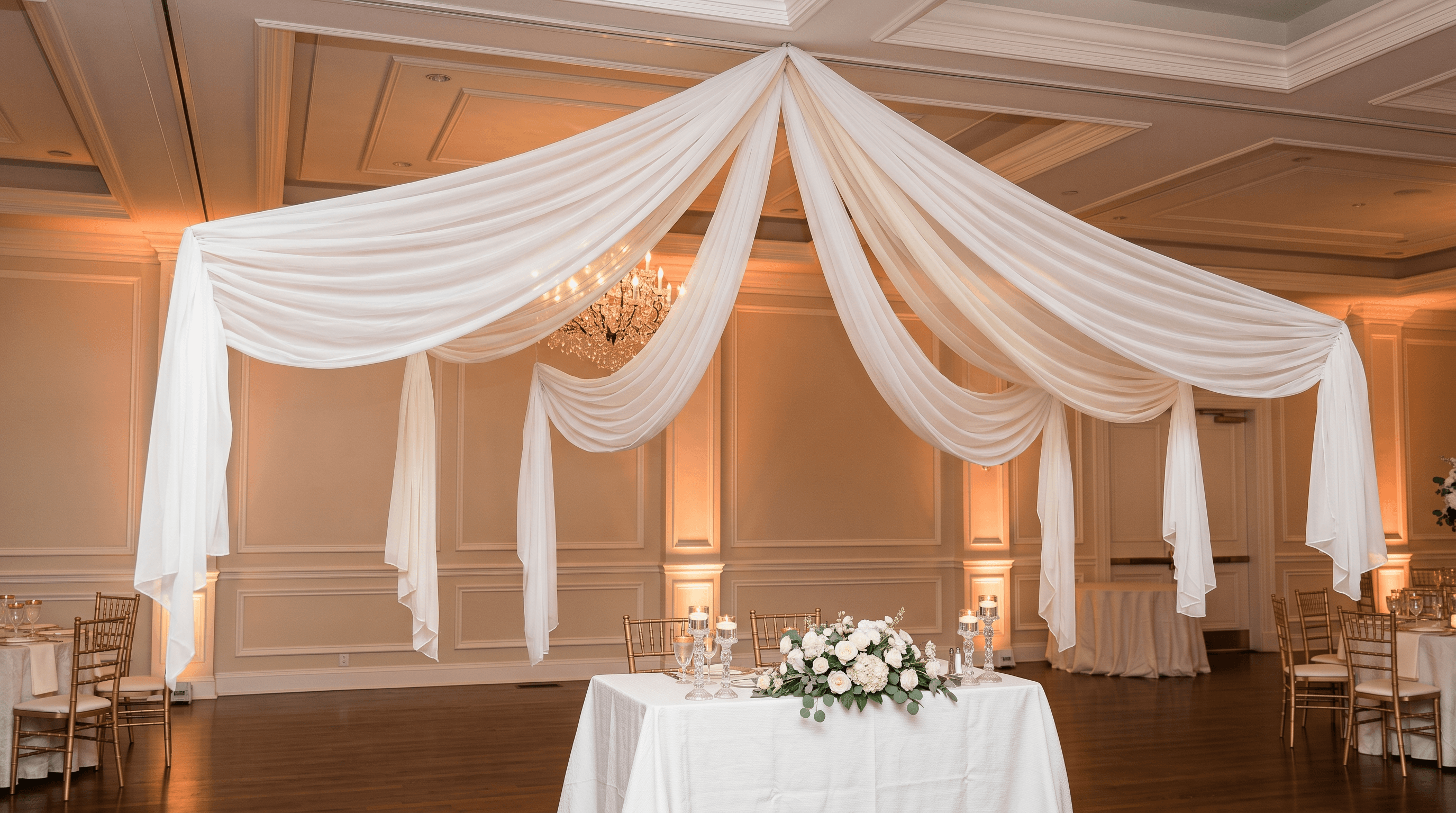
- Spider draping, ceiling-to-floor draping, and any rigging attached to the venue's structure puts load on building components. If a rig fails and injures a guest or damages the venue's ceiling, the claim amount can be substantial. Venues that allow rigging by outside vendors almost universally require COI with higher coverage limits than standard setups — often $2,000,000 per occurrence or more.
- Bounce houses and inflatables
- High-frequency injury claims, strict age and weight limits, wind restriction requirements, and anchoring requirements make inflatables one of the most scrutinized rental categories. Many venues prohibit them entirely. Those that allow them require COI from any inflatable rental company operating on their property — and many require the specific inflatable to be listed on the policy.
What to Ask Any Rental Company Before You Book a Venue Event
These are the four questions that separate professional event rental companies from vendors who haven't formalized their operation:
- 1"Do you carry commercial general liability insurance?" — The answer should be yes immediately. Any hesitation, any "let me check," any "we have personal insurance" is a red flag.
- 2"Can you provide a Certificate of Insurance naming our venue as additional insured?" — The answer should be yes, and they should be able to tell you the process (contact their broker, typically 24–48 hours). If they've never done this before, they've never worked at a venue that enforces the requirement — which means they've been operating without it.
- 3"What are your coverage limits?" — Most venues require a minimum of $1M per occurrence and $2M aggregate. Know your venue's requirement before you ask so you can confirm the vendor meets it.
- 4"Is your business licensed to operate in California?" — A sole proprietor operating without a business license and commercial insurance is not equipped to work at a venue that enforces vendor requirements. This isn't about gatekeeping — it's about making sure the person installing equipment at your event is accountable for what they install.
The Other Side of Insurance: Why It Protects You Too
The COI conversation is usually framed around what the venue requires. But there's a second reason to hire insured vendors that has nothing to do with venue requirements: if something goes wrong at your event and the rental equipment was involved, you want the rental company's insurance to respond — not your homeowner's policy, not your personal savings, and not a civil judgment against you as the event host.
When you hire a licensed, insured rental company and something goes wrong with their equipment, the liability chain runs through them and their carrier. When you hire an uninsured vendor and something goes wrong, you are the last stop in a liability chain that has no other backstop. That's the real risk — not the venue requirement, but your personal exposure if you've hosted an event where an uninsured vendor's equipment caused harm.
We are a licensed, insured event rental company serving Sacramento, Elk Grove, Roseville, Folsom, and surrounding areas. We provide COIs for all venue events — just send us the venue's requirements and we handle the rest.
Get a Quote →Planning a venue event in Sacramento?
Wedding receptions at hotels, ballrooms, and event centers — tents, draping, tables, chairs, dance floors, and full setup by a licensed and insured crew.
Wedding Rentals Sacramento →Quinceañera receptions at banquet halls, church venues, and event centers — full-service rental with COI provided for any venue.
Quinceañera Rentals Sacramento →Corporate events and government contracts — licensed vendor with commercial general liability coverage and all documentation provided.
Corporate & Government Event Rentals →Keep reading:
Spider draping, ceiling-to-floor draping, and wall draping — which venues allow it, what the installation requires, and why it starts with a site visit.
Spider Draping: The Ceiling Treatment That Transforms Any Venue →How to plan a quinceañera in Sacramento — the complete rental checklist including what to ask every vendor you hire.
Quinceañera Planning Guide →
Fiesta Party Event Rentals team
Sacramento, CA · Husband-and-wife owned