Draping8 min read
What Is Spider Draping — And Why It's the Most Dramatic Thing You Can Do to a Venue Ceiling
Most event design fights for attention at eye level. Spider draping wins the ceiling — and when guests walk in and look up, that's when you know the room is done right.
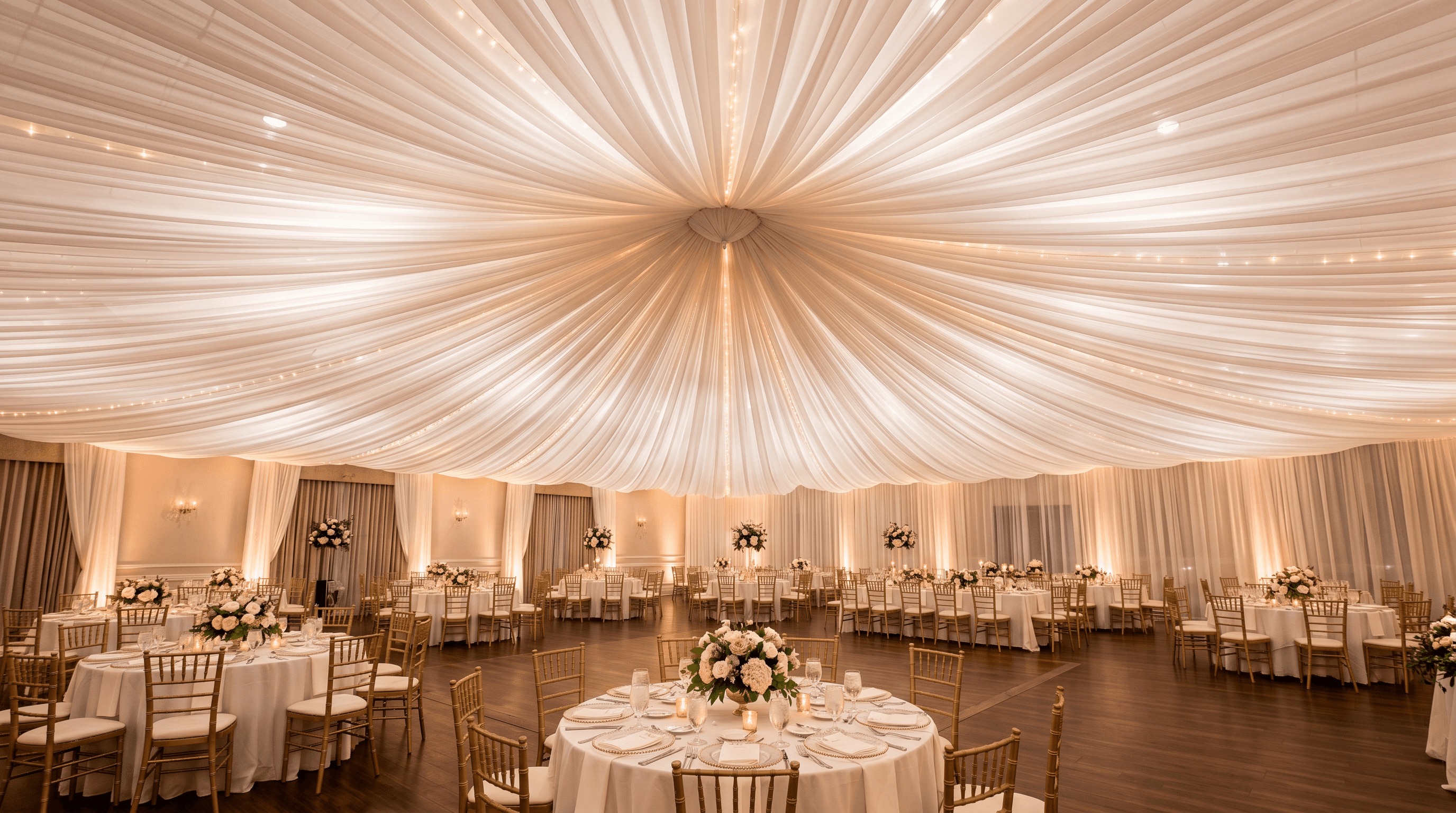
Walk into almost any event and you'll see the same pattern: the tables are immaculate, the florals are stunning, the linens are pressed, the lighting is warm — and then you look up. Fluorescent panels. Drop-grid ceiling tiles. Exposed HVAC ductwork. A fire sprinkler grid. Whatever the venue was built to do, the ceiling was designed for maintenance access, not for a wedding.
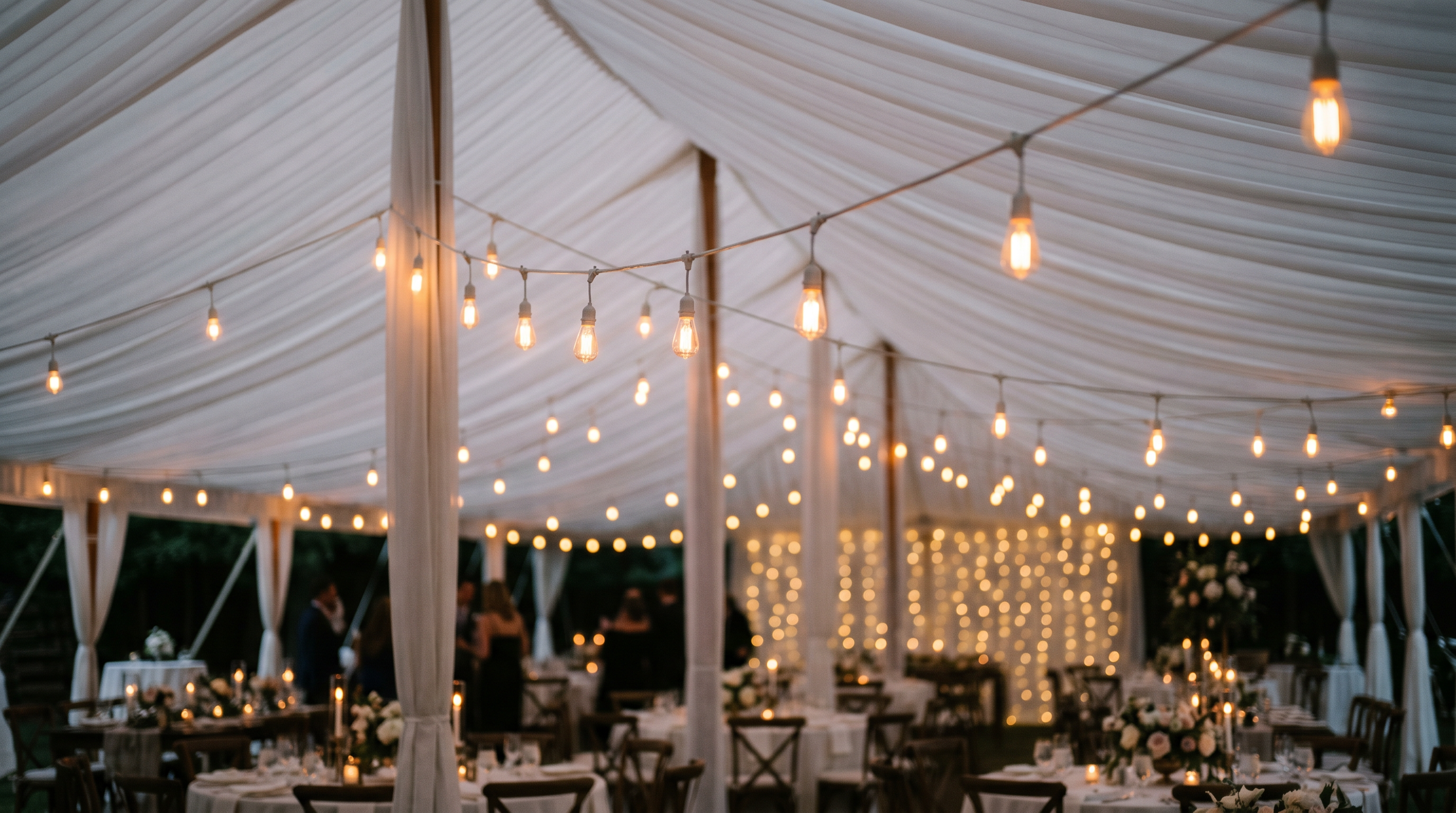
Spider draping solves that problem completely. Fabric panels radiate outward from a single center anchor point mounted to the ceiling — sweeping down and out in every direction like the spokes of a web — until the entire ceiling above your guests is soft white fabric, lit from within, with nothing institutional visible anywhere. It is the single most dramatic transformation you can make to an indoor event space, and it happens entirely above eye level, which means it hits guests the moment they walk through the door before they even look at the tables.
How Spider Draping Actually Works
The installation centers on one thing: a single anchor point at the ceiling, positioned directly above the room's focal point — the dance floor, the sweetheart table, or the room's geometric center. From that anchor, fabric panels extend outward in all directions under tension, held at the perimeter by secondary attachment points at the walls or columns. The result is a continuous fabric canopy that covers the ceiling from center to edge with no gaps, no seams visible from below, and no structural ceiling elements showing through.
The name comes from the radial pattern. From directly below the center anchor, the panels fan out in every direction the way a spider's web radiates from the center — evenly spaced, under tension, with each panel pulling against the others to keep the whole installation taut and smooth.
Two Styles: Focal Point vs. Full Room
Spider draping isn't one-size-fits-all. There are two distinct approaches, and the right one depends on your venue, your budget, and how complete a transformation you want.
- Focal point treatment
- Fabric panels radiate from a center anchor and cover the ceiling above a specific area — the sweetheart table, the head table, or the dance floor — while the surrounding ceiling remains open. The canopy terminates in free-hanging edges that trail down at the perimeter of the treatment area, which makes the center focal point feel framed and intentional. This is what most clients start with. It's the most visible transformation per dollar, it photographs extremely well from every angle, and it works in venues where a full-room installation isn't structurally feasible. If your budget or venue has limits, this is where to put the money.
- Full room coverage
- Fabric panels cover the entire ceiling from the center anchor to all four walls — every inch of ceiling above your guests is fabric. The room feels like the inside of a luxury marquee tent built inside your venue. No ceiling tiles, no ductwork, no grid, no institutional lighting fixtures visible anywhere. This is the treatment you see at high-end ballroom weddings and large quinceañera receptions where the venue transformation is total. It requires more material, longer installation time, and a ceiling structure that can support attachment points at the full perimeter — which is why it always starts with a site visit.
Not sure which approach fits your venue? We assess both options during the site visit and give you a proposal for each.
Request a Site Visit →Why Spider Draping Always Requires a Site Visit
Every other draping product we offer can be quoted from a room measurement. Spider draping cannot. The reason is the ceiling anchor — and everything that flows from it.
- The anchor point has to hold
- Spider draping puts significant downward and lateral load on the center attachment point. That point needs to be a structural ceiling element — a beam, a joist, a rigging point, or a track that was designed to bear weight. Not every venue ceiling offers this. Some have drop-grid ceilings with no structural members within reach. Others have HVAC or lighting infrastructure directly in the center that blocks access. We need to see the ceiling to know what's there and what it can support.
- Ceiling height changes everything
- The higher the ceiling, the steeper the angle at which panels descend from the center anchor — which changes the drape, the fabric quantity, and the visual effect. A 12-foot ceiling produces a flatter, more tent-like canopy. A 20-foot ceiling produces a dramatic peak with panels sweeping down at a steep angle. Both are beautiful, but they require different panel lengths, different tension configurations, and different hardware. This cannot be calculated from a floor plan.
- Room shape affects panel distribution
- A square room distributes panels evenly in four directions from the center. A rectangular room requires longer panels on the long axis and shorter panels on the short axis to maintain even tension. An L-shaped room, a room with columns, or a room with alcoves each require a custom panel layout. Getting this wrong means uneven tension, sagging panels, or gaps in coverage — none of which are acceptable on installation day.
- Perimeter attachment varies by wall type
- Where the panels terminate at the walls or columns matters as much as where they originate at the center. Some venues have wall tracks we can connect to. Others require weighted floor stands at the perimeter. Some have columns that serve as perfect anchor points. Others have nothing. The perimeter plan is as important as the ceiling anchor, and it can only be determined on-site.
Where Spider Draping Works Best
- Hotel ballrooms
- The most common venue for spider draping. Ballroom ceilings are typically high, structurally accessible, and already have some form of rigging infrastructure from prior events. Full-room coverage in a ballroom is the signature look for weddings and large quinceañera receptions. The ceiling height creates the dramatic sweep that makes the installation look like a purpose-built venue.
- Banquet halls and event centers
- Stand-alone event venues often have higher ceilings and more accessible structure than repurposed buildings. Many already have rigging tracks or beam access. Full-room spider draping in a banquet hall completely redefines the space — the same room looks fundamentally different with and without the ceiling treatment.
- Church halls and parish rooms
- High ceilings, exposed beam structures, and large open floor plans make many church halls ideal for spider draping. The exposed beam typically provides a natural anchor point, and the ceiling height creates the dramatic drape angle that makes the installation visually striking. Popular for quinceañera receptions and anniversary celebrations held in parish facilities.
- Corporate event spaces
- Spider draping over the main stage or presentation area at a corporate event or gala creates a focal point that signals this is a curated, designed experience — not a standard conference setup. Focal-point treatment over the presentation stage or awards area is the most common corporate application.
- Warehouses and industrial venues
- Industrial spaces have high ceilings and exposed steel structure — which is actually ideal for rigging. The contrast between the raw industrial bones of the building and the soft white fabric canopy suspended below is one of the most dramatic visual effects in event design. The ceiling anchor attaches to the steel, the panels sweep down, and what was a warehouse becomes a reception hall.
What to Pair With Spider Draping
Spider draping transforms the ceiling. These elements complete the room:
- Uplighting
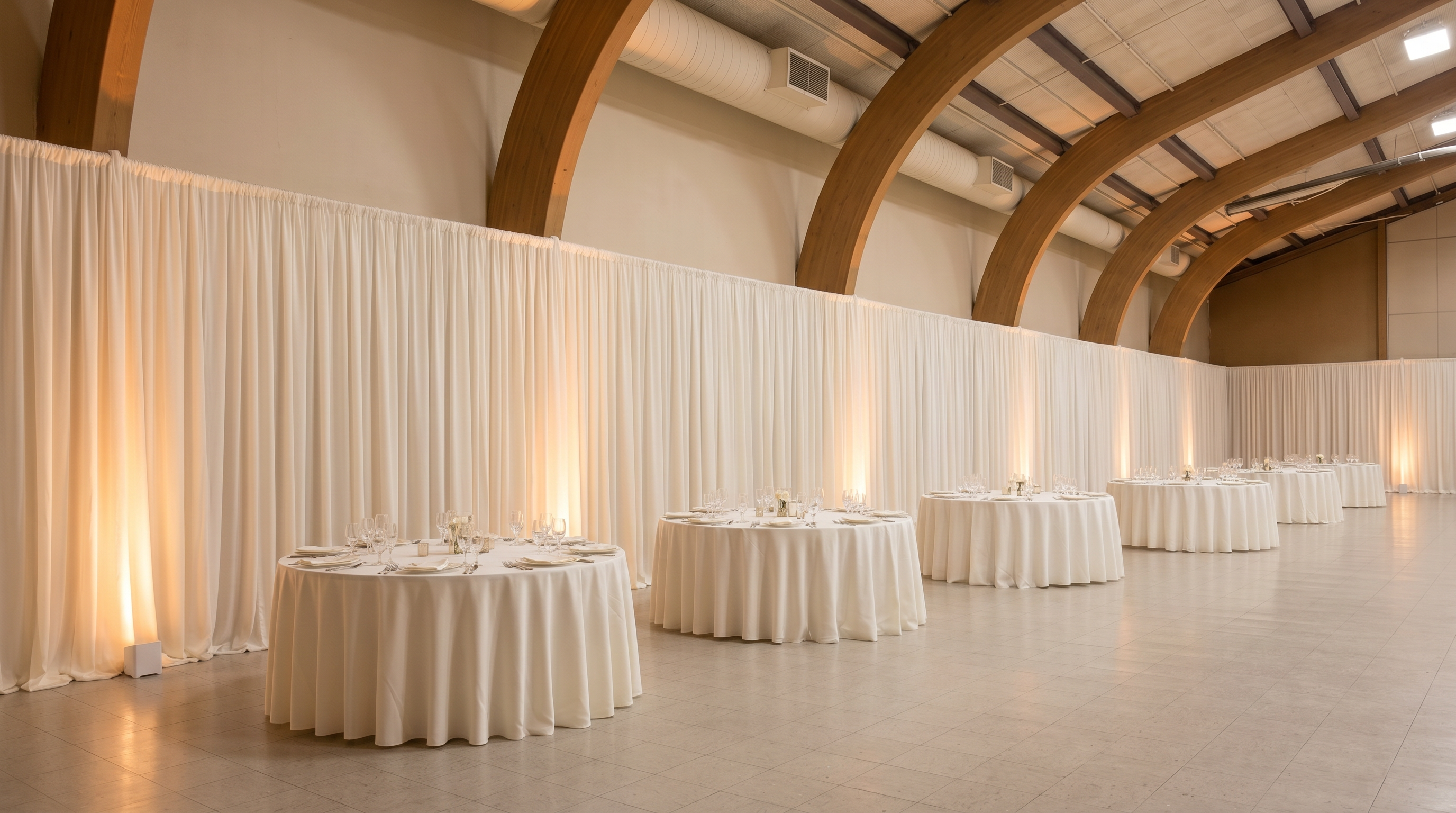
- Floor-level uplights positioned around the room's perimeter wash warm light upward onto the fabric canopy from below. This is what gives spider draping its characteristic glow — the fabric diffuses the light and the entire ceiling becomes a luminous surface rather than a flat white plane. Without uplighting, spider draping looks clean. With uplighting, it looks like it's lit from within. This is not optional if you want the full effect.
- Wall draping
- Spider draping covers the ceiling. Wall draping covers the walls. Together, they give you complete perimeter enclosure — fabric on every surface, nothing institutional visible anywhere in the room. This is the full transformation: the ceiling becomes soft fabric above, the walls become soft fabric around, and the room is defined entirely by the fabric enclosure rather than the building structure. The combination is what separates a decorated venue from a transformed one.
- A chandelier or pendant light at the center
- The center anchor point is the visual focal point of the entire ceiling installation. A chandelier, a floral arrangement, or a pendant light hung at the anchor transforms it from a hardware point into an intentional design element. The fabric radiates outward from the chandelier, which makes the light fixture look like the source of the whole installation. This is the detail that takes spider draping from impressive to unforgettable.
Spider draping starts with a site visit. Reach out with your venue, event date, and what you're envisioning — we'll schedule the visit and come back with a custom proposal.
Request a Site Visit & Custom Proposal →Planning a specific event?
Wedding ceiling draping, wall draping, uplighting, and full venue transformation — see everything we offer for Sacramento weddings.
Wedding Rentals Sacramento →Quinceañera receptions in ballrooms, church halls, and banquet venues — spider draping is one of the most requested upgrades.
Quinceañera Rentals Sacramento →Corporate galas and award dinners — focal-point spider draping over the stage or main table creates the right atmosphere.
Corporate Event Rentals →Keep reading:
Wall draping covers the walls. Here's how we transformed a school gymnasium into a graduation ceremony venue using the same fabric.
How Wall Draping Transforms Any Venue →Tent draping transforms outdoor event ceilings. Here's how it works and when to use it.
Why Tent Draping Transforms Any Outdoor Event →The three layers of event lighting — and how uplighting completes any draping installation after dark.
Complete Event Lighting Guide →
Fiesta Party Event Rentals team
Sacramento, CA · Husband-and-wife owned